Day 20: A normal week ahead.

Day 20: A normal week ahead.

I am a change agent by nature. I enjoy change and adapt to it quickly. However, I also enjoy my routines. The last 20 days I have been robbed of my routines. It is exciting to look ahead at a mostly normal week… I think… You know… there is always the possibility of a surprise test being ordered. I imagine this is a bit of the calm before the storm in some ways. The whole hurry up and wait phase…

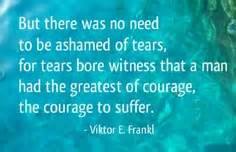
Friends and fellow cancer warriors keep reminding me to allow myself tears. Even one of my doctors felt the need to remind me that I am “human.” LOL FUNNY stuff! Tears are hard for me. As the oldest child, it is your job to be the strong one. As a female executive you beat down emotion because tears and emotion are perceived as weakness, instability, symbolic of being unable to exercise self-control, and ultimately used against you. I have a lifetime of playing whack-a-mole with any emotion that fell outside of happiness or anger and a great amount of pride in being able to do so. However, I know this is different and it will be necessary. I know it will happen whether I wish to “allow it” or not. This brought me to another Viktor Frankl quote (image below).

I have cried. I “flash cried” diagnosis day when I was given the news by the radiologist 19 days ago – he could tell I already knew and said as much. I “flash cried” that same afternoon when I told my executive committee. I have cried a few times with friends and family. Even a few good cries in my safe zones that made my eyelashes hurt the next day (who knew that could happen?) and I know I will certainly cry more. I guess we could consider these training sessions as I find my way back to some emotions I have beat down for awhile. LOL

However, ultimately, I do believe it is my pathological optimism that will bring me through all this and help me to be an even stronger and more dedicated warrior than before.

Have a beautiful day!!

‪#‎strongerthancancer‬ ‪#‎embracingtheadventure‬ ‪#‎killerleftboob‬ ‪#‎hawtrightboob‬ ‪#‎breastcancer‬

Frankl Meme Tears

Day 19: Meet Infiltrating (or Invasive) Lobular Carcinoma (ILC).

Day 19: Infiltrating (or Invasive) Lobular Carcinoma (ILC). Today’s post is more informational. This is the shortest write-up I have found ILC. As I think about the pros and cons of unilateral vs. bilateral, there is a lot of information even in this short article that make me lean toward bilateral. Especially the part where a mammogram won’t always catch it. This is an interesting process as you think about “removing” a part of your body. Especially when you are thinking about possibly removing part of you by choice… which we really won’t know until MRI results come back.

I was talking with an amazing friend last night and finally just shrugged my shoulders and said, “Me over-thinking, ugh… this is just vanity.” My friend says, gently, “Are you sure you aren’t confusing vanity with identity.” WOW. You need friends like that. It was a hard thing to ask and they were very aware of the impact of the question. It is identity. I do need to recognize that. Now… for the informational part:

ILC starts in the milk-producing glands (lobules). Like IDC (ductal), it can spread (metastasize) to other parts of the body. About 1 in 10 invasive breast cancers is an ILC.

Signs and Symptoms: ILC does not always feel like a breast lump. ILC cells may leave your lobes through one opening, staying together in a line. They can proceed to infiltrate fatty tissue, creating a web-like mass. This web of cancer cells may feel like a thickened area of breast tissue, and at first may not cause concern or pain. Unfortunately, if left undetected, ILC can develop into a mass that is about 3/4 inch (2 centimeters) to about 2 inches (5 centimeters) or bigger in size, before causing more noticeable symptoms.

When to Seek Medical Help: If you have any of these symptoms, get them checked out by a health professional right away:
A thickened area within your breast
An area that feels “full” or swells (not due to lactation or hormonal cycle)
Breast skin changes such as dimpling, thickening, or different texture
Nipple drawing in (retracting)

Because ILC can easily hide within breast tissue, a mammogram won’t always catch it, particularly in the earliest stages. If it does show up on a mammogram, it will be unclear as to its actual nature. Your doctor may send you for a breast ultrasound, which is better at detecting ILC than a mammogram. To get the best overall image of the cancer, you may need a breast MRI, so your surgeon will be able to see the size and location of the mass. Finally, to get a clear diagnosis of ILC, a breast biopsy must be done, so that a sample of the tissue can be examined by a pathologist.

Stages of ILC: ILC can be diagnosed from stages 1 through 4. It is more likely than IDC to occur in both breasts -– about 20% of patients diagnosed with ILC will have bilateral breast cancer. A breast MRI will help reveal this, and treatment can be tailored to combat both cancerous masses at once.

‪#‎strongerthancancer‬ ‪#‎embracingtheadventure‬ ‪#‎killerleftboob‬ ‪#‎hawtrightboob‬ ‪#‎breastcancer‬